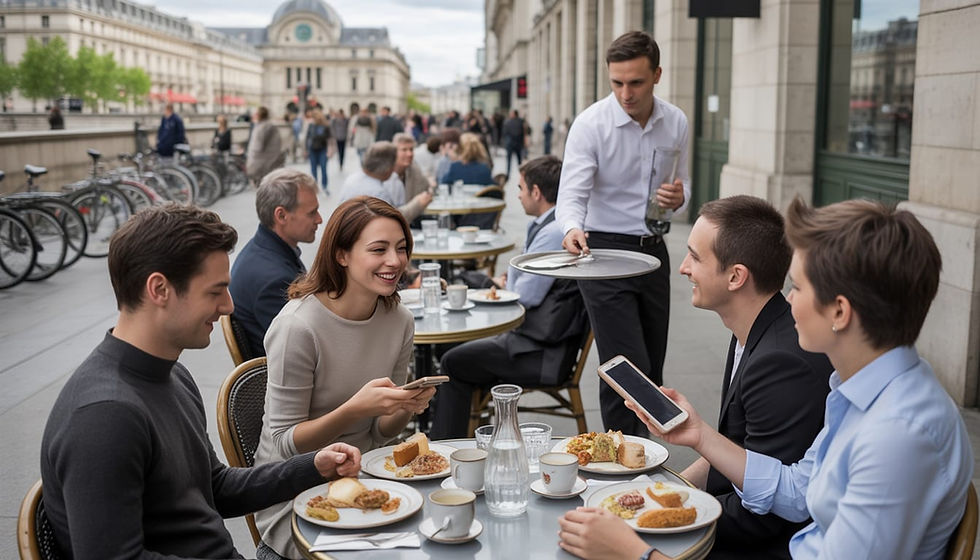
The History of Restaurants in France: From Restorative Broths to the Art of Dining
Updated: Jun 26
The History of Restaurants in France: From Restorative Broths to the Art of Dining
There is a particular kind of silence that falls over a Parisian dining room just before the first course arrives — the hush of anticipation, of white linen and candlelight, of a ritual about to begin. That ritual has a history, and it started here, in France.
France didn't simply perfect sauces and wine pairings. It invented the modern restaurant as we know it — the idea that a person could walk into a room, choose from a written menu, sit at their own table, and be served at their own pace. That concept, which feels entirely natural today, was genuinely revolutionary when it emerged in 18th-century Paris.
Understanding this history changes how you experience France at the table. It explains why certain rooms feel the way they do, why French service has its particular cadence, and why a meal here can still feel like an occasion rather than just a meal.
Before Restaurants: Auberges, Taverns, and the Tyranny of the Fixed Table
Before the mid-1700s, travelers in France ate where they could: at inns (auberges), taverns, or private homes. Meals were communal and fixed — you arrived at a set hour, sat at a shared table, and ate whatever was being served that day. There was no menu, no choice, and no concept of the customer's preference.
Which is precisely what made the restaurant's emergence so striking.
The Birth of the Restaurant in 18th-Century Paris
The word restaurant comes from the French restaurer — to restore. In the mid-18th century, specialized shops in Paris began selling restoratifs: nourishing broths and preparations intended to revive the health of weary Parisians. Gradually, these establishments expanded their offerings and began to welcome individual diners at private tables.
One of the most frequently cited figures in this story is a man known as Boulanger, who sold restorative soups near the Louvre in the 1760s. Whether or not every detail of his story is historically verified, what matters is the idea he represented: a place built around the individual diner, not the communal table. A place where you chose, rather than accepted.
By the time the first edition of the Almanach général de France listed Parisian establishments in the 1760s, the concept was already spreading.
The French Revolution and the Democratization of Fine Dining
The Revolution of 1789 transformed French society — and, unexpectedly, French dining. As aristocratic households collapsed, the highly trained chefs, maîtres d'hôtel, and kitchen brigades that had worked in private service suddenly found themselves without employers.
Many opened their own establishments. The skills that had fed the nobility now fed the public. Menus became more sophisticated, competition intensified, and the restaurant — as a cultural institution — was born.
Paris in the 1790s and early 1800s saw an explosion of dining rooms, each developing its own identity, its own specialty, its own clientele. The restaurant had become a stage.
The 19th Century — Grandeur, Brasseries, and the Codification of French Cuisine
The 19th century gave French dining its structure. Auguste Escoffier codified classical French technique, establishing the kitchen brigade system still used in professional kitchens worldwide. Multi-course meals became standardized. Service à la russe — where dishes are brought out in sequence rather than placed all at once — replaced the earlier, more chaotic service à la française.
This was also the era of the great Parisian brasseries: lively, all-day establishments born partly from Alsatian immigration and the culture of beer halls. Places like Brasserie Lipp on Boulevard Saint-Germain became gathering points for writers, politicians, and artists — tables where culture was discussed as much as food was consumed.
If you want to understand why Paris feels the way it does at the table, the 19th century is where much of that atmosphere was written.
The Michelin Guide and the Rise of Culinary Tourism
In 1900, André and Édouard Michelin published the first edition of their guide — originally a practical tool for motorists, listing hotels, garages, and restaurants along French roads. By 1926, the guide had begun awarding stars to exceptional tables. By the mid-20th century, a Michelin star had become the most coveted distinction in the culinary world.
The Guide Michelin did something remarkable: it turned restaurants into destinations. People began traveling specifically to eat. The concept of gastronomic tourism — which is at the heart of everything we do at Gastronomos — has its roots in that early 20th-century shift.
Lyon, the Regions, and the Mères Who Changed Everything
The history of French restaurants is not only a Parisian story. Lyon — which Paul Bocuse called the gastronomic capital of the world — had its own tradition: the bouchons, intimate working-class restaurants serving hearty Lyonnaise cuisine, and the legendary Mères Lyonnaises, women cooks who ran their own establishments and earned Michelin stars before most chefs could spell the word.
Figures like La Mère Brazier, who received three Michelin stars in 1933, remind us that French culinary excellence has never belonged to one city, one gender, or one style. Each region — Brittany with its seafood, Alsace with its choucroute, Provence with its olive oil and herbs — tells its own story at the table.
These regional identities are very much alive today, and experiencing them is one of the great reasons to travel through France beyond Paris. If you're curious about regional gastronomic journeys, we'd love to help you design one — tell us where you want to go.
Where to Feel French Dining History Today
Some addresses in Paris carry this history in their walls. You don't need to do anything special — just arrive, sit down, and pay attention.
Le Procope — 13 Rue de l'Ancienne Comédie, 75006 Paris. Opened in 1686, it claims to be the oldest café-restaurant in Paris. Voltaire, Rousseau, and Napoléon Bonaparte all passed through these rooms.
La Tour d'Argent — 15 Quai de la Tournelle, 75005 Paris. Founded in the 16th century, it has one of the oldest wine cellars in France and a view of Notre-Dame that makes the duck à la presse feel almost secondary.
Bouillon Chartier — 7 Rue du Faubourg Montmartre, 75009 Paris. A 19th-century bouillon — a workers' canteen concept born in the 1860s — now beloved by Parisians and visitors alike for its honest prices and magnificent Belle Époque interior.
These are not tourist traps. They are living chapters of the story.
For a curated itinerary that weaves historic dining rooms with contemporary tables and hidden neighborhood bistros, explore our Paris food experiences or contact us to plan your trip.
What You're Really Sitting Down For
When you take your seat in a French restaurant — whether it's a three-Michelin-star kitchen in Paris or a family-run bistro in Burgundy — you're participating in something that took three centuries to build.
You're sitting down for technique, for hospitality as a philosophy, for the idea that a meal is not fuel but culture. That the table is where conversation happens, where relationships are cemented, where a country expresses what it values.
France invented the restaurant. But what it really invented was the idea that eating together deserves to be taken seriously.
If that idea resonates with you, I'd love to help you experience it firsthand. Whether you're planning your first trip to France or your tenth, a well-chosen table changes everything. Let's talk about your trip.