French Winter Food: 5 Classic Dishes the French Love When It's Cold
Updated: 4 days ago

It starts with the windows. Sometime in November the bistro windows of Paris fog up from the inside, and through the mist you can make out a copper pot on the counter, a slate with pot-au-feu chalked in white, a couple sharing a bottle of red at four in the afternoon. Winter has arrived, and in France the menu changes before the weather does.
The classic French winter foods are melted-cheese dishes from the mountains, such as raclette, fondue and tartiflette; slow-cooked stews like pot-au-feu, bœuf bourguignon and cassoulet; winter seafood, above all oysters and scallops; soups and gratins; and charcuterie and preserved meats. Most are at their best from November to February, and almost every one belongs to a region.
Why the French eat differently in winter
Before refrigerators and supermarkets, winter was a season of scarcity. Kitchens relied on what could be stored, salted, smoked or simmered: cheese aged in mountain cellars, root vegetables kept in the dark, meat preserved in its own fat. Long cooking kept the house warm and turned the cheapest cuts into something tender.
Those constraints became traditions, and the traditions became the dishes the French still crave the moment the temperature drops. In 2010, UNESCO recognised the gastronomic meal of the French as intangible cultural heritage, and nowhere is that ritual more alive than at a winter table: slow, shared and generous.
1. Melted cheese from the mountains

The word raclette comes from racler, to scrape. In the Valais and in Savoie, half a wheel of cheese was set by the fire and the melted surface scraped over boiled potatoes, and the gesture has barely changed. Fondue savoyarde blends Beaufort, Comté and Emmental de Savoie with dry white wine, and Raclette de Savoie even has its own protected geographical indication, recorded by the INAO.
Tartiflette is younger than it looks, created in the 1980s to promote Reblochon, which tells you how quickly a good idea becomes a tradition here. Further south, in the Aubrac, aligot stretches potatoes and fresh tomme into ribbons that seem never to end. And then there is Mont d'Or, sold only from autumn to spring, baked whole in its spruce box with a splash of Jura white wine. If you would rather someone else did the melting, here is where to eat raclette and fondue in Paris.
2. Stews that simmer all morning

Pot-au-feu may be the most French dish of all: beef, marrow bones, leeks, carrots and turnips poached for hours, the broth served first and the meat after, with coarse salt, mustard and cornichons. Burgundy gave the world bœuf bourguignon and coq au vin, both braised in red wine, while blanquette de veau is the gentle, creamy one families make on Sundays.
In the southwest, cassoulet, white beans with confit duck, sausage and pork, is claimed with equal passion by Castelnaudary, Carcassonne and Toulouse. In Alsace, choucroute garnie fills the winstubs, especially in December, when the Christmas markets turn every village into a postcard. Every region has its pot, and every family its version.
3. Winter seafood, the happy surprise

People are often surprised to learn that winter is the best season for oysters in France. The old rule says to eat them only in months with an R, and the cold water keeps them firm and briny. On Christmas Eve they are on almost every table, from Marennes-Oléron, from Brittany, or from the Arcachon Bay, my personal weakness, plump and saline.
It is also the season for coquilles Saint-Jacques, the scallops of Normandy and Brittany, seared in a little salted butter and nothing more. If you are in Paris for the holidays, our Christmas guide explains what lands on the réveillon table.
4. Soups and gratins

When the days are short, soups return to French tables: leek and potato, pumpkin velouté, and the onion soup gratinée that Parisians once ate at dawn in the old market of Les Halles. Gratins do the rest. Endives wrapped in ham under béchamel, gratin dauphinois with cream and garlic, cardoons in Lyon at Christmas: humble food, finished with a golden crust.
5. Charcuterie and preserved meats
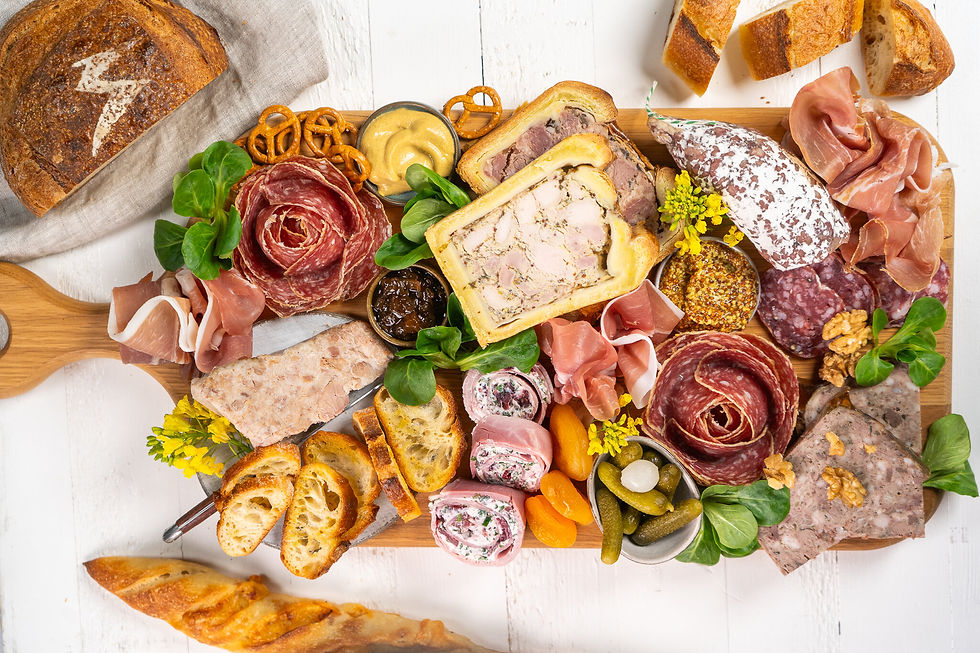
Late autumn was traditionally the time of the tue-cochon, when families killed the pig and prepared everything that would carry them through the winter: hams to dry and smoke, saucissons, pâtés, rillettes, and confit of duck and goose stored in its own fat. That is why the mountains and the southwest have such an extraordinary variety of cured meats.
It is also why a board of charcuterie and cheese with a glass of wine still feels like the most natural thing in the world on a cold evening; here are the cheese and wine pairings that actually make sense. And for the most luxurious winter flavour of all, black truffle season runs from December to March.
Where and when to taste French winter food
The season runs from November to February. Paris has a little of everything, but each dish tastes best at home: mountain cheese in Savoie and the Jura, cassoulet in the southwest, choucroute in Alsace during the Christmas markets, truffles in Provence and the Périgord in January, oysters on the Atlantic coast. Winter is also the quietest time to travel: no queues, and producers who finally have time to talk.
Travel through a French winter with me
Winter is one of my favourite seasons to explore France: the markets are full, the cellars are calm and the tables are warm. If you dream of a journey built around truffles, mountain cheese or a Christmas in Alsace, write to me and I will design it with you.


